What lies beyond soaking in a hot spring?
It’s a question many have probably felt at some point. The onsen culture that we Japanese have nurtured for generations is now taking on a new role, one that goes beyond simple recovery from fatigue. In this series, Daiki Toshima, a nature therapist who has long been involved in producing nature therapy and retreat programs, shares the insights he has gathered in the field, in his own words.
The previous column explored the long relationship between hot springs and people. Since the days when humans were simply creatures living within nature, hot springs may have been a place for warming the body and sustaining life. That practice became toji, a culture unique to Japan, and it continues to be passed down in our daily lives.
Today, however, what needs recovering seems to have changed somewhat.

In the past, working with the body was a given, whether in farming, forestry, or fishing. Hot springs therefore played a major role in restoring bodies pushed to their limits.
Medicine was also underdeveloped, and treatment options for illness were limited. Strengthening the body’s natural healing power at a hot spring was an important part of convalescence and recovery.
And what about us today? Our bodies still get tired, of course.
But isn’t it something else that wears us out even more: the stress of information overload, and time that rushes by? AI has advanced and life has become convenient. Yet we are constantly checking our smartphones, taking in a flood of information day after day, and losing time to rest the mind without even realizing it.

Ours is also an age in which people choose their own way of living.
Unlike societies of the past, where status and occupation were fixed, we keep asking ourselves “Who am I?” and “How do I want to live?” as we make our way through life. That is why “recovery” today means more than recovering from fatigue.
Amid an overflow of information and choices, a retreat is where a person themselves is restored. A retreat can also be seen as time for reclaiming the self as an individual.
It is a journey from the “person” who plays a role in society back to the “human” who is simply natural, as one was born. This is also what it means to be one’s authentic self, the self that feels most like oneself.

In this sense, a new role seems to be emerging for onsen towns. Soaking in the hot spring is, of course, important. But it is not the whole picture.
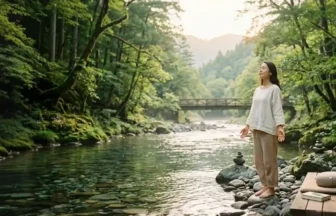
Listening to birdsong.
Eating the seasonal food of the land.
Feeling the four seasons.
Quietly settling the breath.

Through such time, people gradually regain the rhythm of nature.
This is what I call the nature retreat: an approach in which nature itself is the therapist.
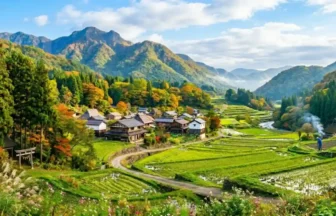
In other words, it is not only about recovering at the hot spring, but about recovering in the hot spring town.
Adding wellness programs from the West to this makes the Japanese retreat richer still. Yoga, mindfulness, journaling, grounding, and other practices developed outside of Japan are wonderful ways to live better.

The future of the Japan Retreat lies in the place where the nature views and onsen culture that Japanese people have cultivated for generations meet modern wellness.

Just as two rivers with different sources merge into one, each tradition’s strengths come together to create new value. The Japan Retreat is born at that confluence.
In my own retreats, I look for the points where the two meet and skillfully weave in the latest work, such as yoga and journaling. It is an attempt to draw out, once again, the restorative power that the climate and character of an onsen town have always held, through the lens of modern wellness.
Going beyond “recovering at the hot spring” to “recovering in the hot spring town”: this idea is what the Japanese Retreat should be, and it is a message to share with the world.
Representative of Holistic Support; Chairman of the Japan Nature Retreat Association; Principal of Kanoyama Nature School; lecturer at hotel and tourism vocational schools.
Qualifications: Health Exercise Instructor, Nature Game Leader, Hot Spring Sommelier.
Publications and media: Persistent Fatigue, Melted Away! The Art of Restorative Retreats (Subarusha), and has appeared on numerous TV programs and other medias.
– Certified Health Coach — IIN (Institute of Integrative Nutrition), USA
– Nutrition & Food Education Consultant (JAFA Certified)
– Psychological Counseling Specialist (JAFA Certified)
– Founder of Japan Retreat Hub